
What You See Inside Kensington Palace
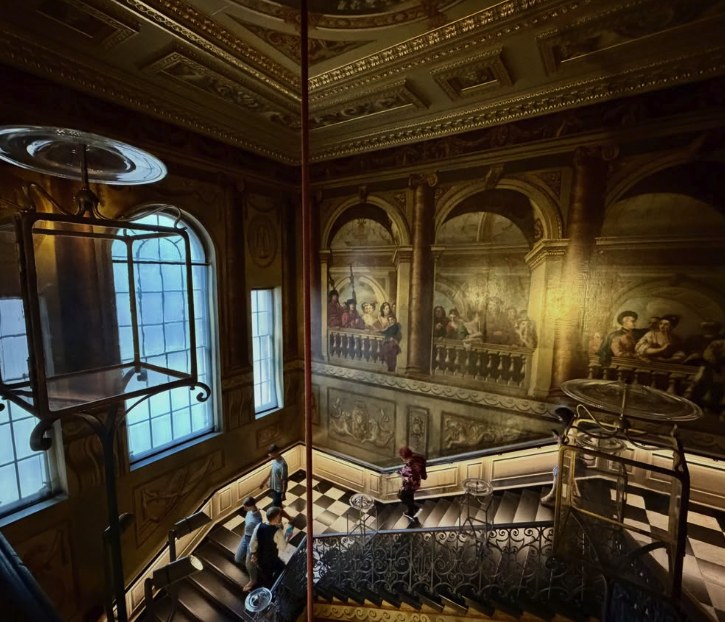
This is a compact palace and you can finish it in ninety minutes. That makes knowing what is in each room worth more here than it would be at a larger one. Below is every room your ticket reaches in 2026, in the order the handset takes them, plus the wing that is shut.
The King's Grand Staircase
You climb this first, and it is the moment most visitors take their first photograph. William Kent painted the walls in the 1720s with a trompe-l'oeil gallery: George I's household leaning over a painted balustrade to look down at you. Peter the Wild Boy is up there, and so are the King's Turkish grooms Mustapha and Mahomet, his Polish page, the yeomen of the guard and Kent himself. Jean Tijou's wrought-iron balustrade runs beside the real stair, and the chequered stone floor below is the one the court walked on.
The Cupola Room, and Kent's first commission
George I gave Kent the Cupola Room in 1722, ahead of the far more established Sir James Thornhill. Kent painted its ceiling in 1723 as a coffered dome that is not there. The room is gilded statues in niches and painted architecture over real architecture, and the infant Victoria was christened in it in 1819. At its centre stands Charles Clay's musical clock, the Temple of the Four Grand Monarchies of the World, finished after Clay's death by John Pyke in 1743. The case is by Roubiliac, the painted dials by Amigoni and the silver reliefs by Rysbrack.
The King's Gallery, and the wind dial of 1694
Ninety-six feet of crimson damask hung with Old Masters from the Royal Collection. Above the chimneypiece is the one thing here that no booking listing mentions: a wind dial made for William III by Robert Morden in 1694. It is a painted map of north-western Europe with the points of the compass around the rim. Its pointer is driven by rods running up to a weather vane on the roof. The corners carry painted scenes of the four continents, probably by Robert Robinson, and Kent designed the marble chimneypiece around it a generation later.
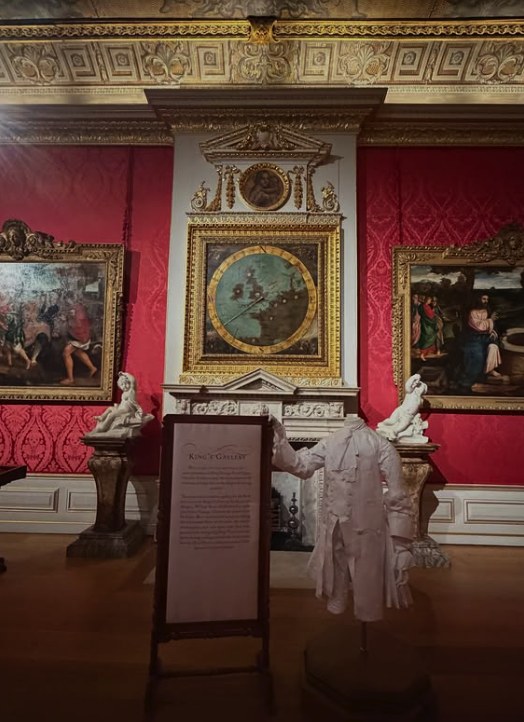
Look up when you walk in. It still works, and it is still telling you which way the wind is blowing over the park outside.
Victoria's childhood rooms, and the bedroom she was born in
The rooms where Victoria grew up are presented as they were rather than as a gallery about her. The bedroom holds a satinwood bed under a green half-tester with a curtained cot beside it, which is the arrangement she was born into on 24 May 1819. Her dolls are here, and her journals, and the toys of a childhood spent under the Kensington System. That regime kept her from sleeping in a room of her own until she was Queen.
The Jewel Room
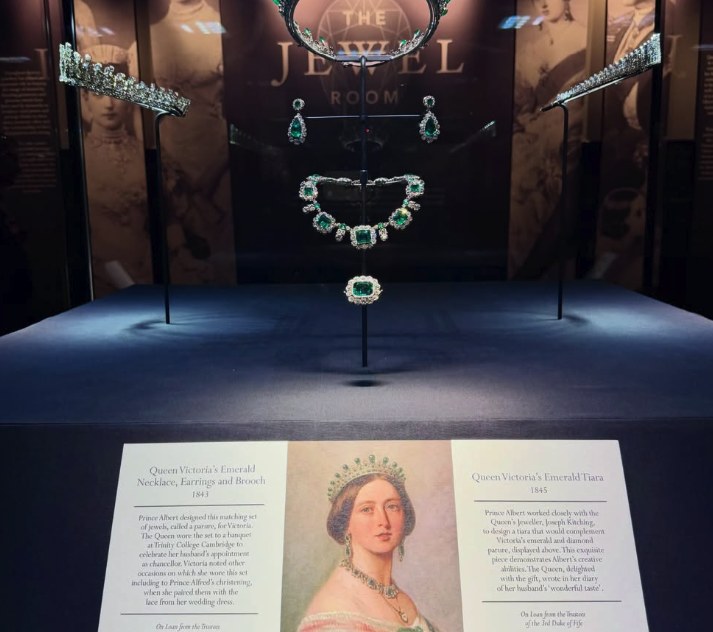
Open year-round and included in standard admission, which is not obvious from any tour listing. The Last Princesses of Punjab, running to 8 November 2026, sits on the same ticket. It holds the emerald parure Prince Albert designed for Victoria with the jeweller Joseph Kitching: the tiara of 1845, and the necklace, earrings and brooch of 1843. Beside them sit the Fife tiara, accepted by the nation in lieu of inheritance tax, and the diamond kokoshnik that belonged to Victoria's granddaughter Princess Louise, Duchess of Fife. Several of these had not been publicly seen for decades.
The Queen's State Apartments, closed until spring 2027
These are the rooms of Mary II and the earliest years of the palace: the Queen's Staircase, the Queen's Gallery and the Queen's Closet. They closed on 15 June 2026 for a conservation and re-presentation project and reopen in spring 2027. Two of the booking listings still name them as a highlight, so it is worth knowing before you arrive rather than after.
| Room | Status in 2026 | Why it matters |
|---|---|---|
| King's Grand Staircase | Open | Kent's painted court, 1720s |
| Cupola Room | Open | Kent's first commission; Victoria christened here |
| King's Gallery | Open | The 1694 wind dial and the Royal Collection pictures |
| Victoria's childhood rooms | Open | The bedroom she was born in, 1819 |
| The Jewel Room | Open, year-round | Victoria's emeralds and the Fife tiara |
| The Last Princesses of Punjab | 26 March to 8 November 2026 | Included in admission |
| Queen's State Apartments | Closed to spring 2027 | Conservation and re-presentation |
| Apartments 1A, 8 and 9 | Private, never open | Residential; not part of any tour |
Room status published by Historic Royal Palaces and checked in August 2026. Confirm on their own site before you travel.
Ninety minutes: what to see first if that is all you have
The order below is the one that works if your afternoon is short. It front-loads the two rooms people photograph and leaves the exhibition last, because the exhibition is the part you can walk through at whatever speed you have left.
- First 15 minutes: the King's Grand Staircase, from the bottom, then again from the top looking back down at the painted court.
- Next 20 minutes: the Cupola Room and the clock, then the King's Gallery with the wind dial and the pictures.
- Next 25 minutes: Victoria's rooms, ending in the bedroom where she was born.
- Last 30 minutes: the Jewel Room and whichever exhibition is running.
Ask the room stewards something. They are the most-praised part of the visit in the traveller feedback and they are not on the handset. For everything outside the door, the gardens covers the Sunken Garden and the Orangery, and the history explains why the building is shaped the way it is. Kensington Palace tours and tickets sets every bookable way in side by side.