
Kensington Palace Gardens
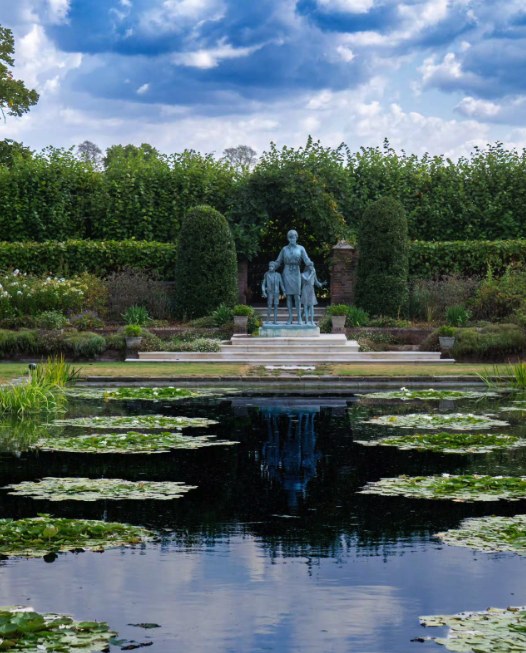
Almost everything below is free, open every day and reachable without a ticket — which makes the gardens the best answer to a Monday, when the palace itself is shut. Here is what is out there, in the order you would walk it.
The Sunken Garden, and the statue in it
You look down into this one rather than walking through it. Edward VII had it laid out in 1908 on ground that until then held potting sheds and greenhouses, modelled on the Pond Garden at Hampton Court: terraced beds around a long ornamental pool, in the formal Edwardian manner. Diana was fond of it, and in 2017 it was replanted white for the twentieth anniversary of her death. Ian Rank-Broadley's bronze of her with three children was unveiled at the far end in 2021.
The Cradle Walk
Palace in the Park, the palace's own guided walk, is the only way down inside this garden rather than looking into it. The garden is enclosed by a walk of trained limes clipped into a continuous arched tunnel, and that walk is where you are meant to stand. The arches frame the view down the pool to the statue, and they are the reason your photographs of the Sunken Garden all look the same as everybody else's: there is one designed vantage point and it works. You can walk it without a ticket at any time the park is open.
The Orangery, built in 1704
Queen Anne had it put up in 1704 to keep her citrus trees alive over the winter, probably to a Wren design executed by Hawksmoor and possibly revised by Vanbrugh. It is a long brick and Portland stone building with tall windows on the south side, and it now serves afternoon tea. The tea walks listed here finish at its tables, and the reservation is a large part of what they sell: it is held in your name before you arrive.
The Italian Gardens and the Long Water
At the north end of the Long Water, a formal water garden of four basins with carved Carrara marble rosettes, the Portland stone and marble Tazza Fountain, and classical statuary around them. It was made for Prince Albert in the 1860s, and it is a fifteen-minute walk from the palace if you come in from the Bayswater side. Several of the garden walks start here rather than at the palace.
The Round Pond
Queen Caroline commissioned the ornamental basin directly east of the palace in the 1720s, and it is still the piece of water everything else in the park is arranged around. Model boats sail on it, swans and geese live on it, and the view back west from its far edge is the one that puts the palace in the middle of the park rather than at the edge of a road.
The Peter Pan statue
Sir George Frampton's bronze went up overnight in 1912, commissioned by J. M. Barrie himself and placed where he had wanted it, on the bank of the Long Water. Barrie set the character in these gardens before he ever put him on a stage. If you have children with you this is the stop they will remember, and it costs nothing.
Physical Energy, and the Albert Memorial
George Frederic Watts's bronze horseman stands on the central axis with views to the Royal Albert Hall, the palace and Henry Moore's arch. South of it, on the edge of the gardens, is the Albert Memorial: Gilbert Scott's gilded Gothic canopy over a seated Prince Albert, finished in the 1870s. Both are free, both are on the way to South Kensington, and both are five minutes apart.
The Diana Memorial Playground
In the north-west corner of the gardens, near the Black Lion Gate, and built around a wooden pirate ship. Entry is free, adults are only admitted with a child, and it is the reason a family morning at Kensington works better than a family morning at most palaces. It is a few minutes' walk from the palace door.
Free to walk, or ticketed: which is which
This is the practical distinction, and it is easy to get wrong from a booking page. The park and everything in it is a Royal Park, open daily from six in the morning until dusk, and costs nothing. Only the palace interior is ticketed.
| Where | Ticket needed | Open |
|---|---|---|
| Sunken Garden and Cradle Walk | No | Daily, 6am to dusk |
| Diana's statue | No | Daily, 6am to dusk |
| Italian Gardens, Round Pond, Long Water | No | Daily, 6am to dusk |
| Peter Pan statue, Physical Energy, Albert Memorial | No | Daily, 6am to dusk |
| Diana Memorial Playground | No | Daily; adults only with a child |
| The Orangery | No ticket to enter; tea is paid for | Palace opening days |
| Inside the Sunken Garden itself | Palace in the Park tour only | Wed and Sun to 20 December 2026 |
| The State Apartments | Yes | Wednesday to Sunday |
Park hours from The Royal Parks and palace hours from Historic Royal Palaces, checked in August 2026. "Kensington Palace Gardens" is also the name of the private road beside the park; the garden described here is the public one.
A ninety-minute route through the park
Start at Queensway, which is what most of the guided walks do. This is the route they follow, and you can walk it yourself for nothing.
- 0–15 minutes: in at Queensway, down to the Italian Gardens at the head of the Long Water.
- 15–30 minutes: south along the water to the Peter Pan statue.
- 30–45 minutes: west across the grass to Physical Energy, then the Round Pond.
- 45–60 minutes: the palace's east front and the Queen Victoria statue.
- 60–75 minutes: round to the Cradle Walk and the view down into the Sunken Garden.
- 75–90 minutes: the Orangery, and a table if you booked one.
Want it told out loud?
The same route, with the royal history in order and a table held at the Orangery when you get there. Every garden walk on the site follows some version of it.
For what the seasons do to all this, the best time to visit takes it month by month, and getting here explains which gate to come in by. Kensington Palace Tours sets every bookable trip side by side.