15 Facts About Kensington Palace That Will Surprise You
1. It was built as somebody's house, not as a palace
The core of the building went up in 1605 for Sir George Coppin, a private gentleman, in a village well outside London. It became Nottingham House under the Finch family and only stopped being a house in 1689.
2. A king bought it because he could not breathe
William III had chronic asthma. Whitehall Palace sat on the damp edge of the Thames with coal smoke blowing across it, and it made him ill. Kensington was two miles of open country away, and that is the whole reason the royal court moved west.
3. The price was £20,000
Paid to Sir Daniel Finch, second Earl of Nottingham, in 1689. It is one of the few English royal palaces bought on the open market rather than seized, inherited or built.
4. Wren extended it rather than replacing it
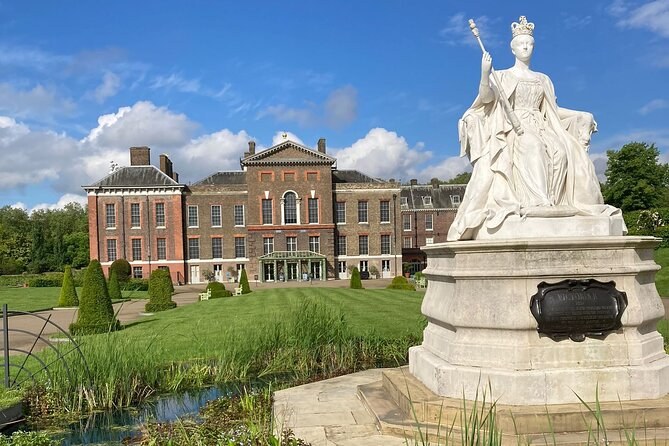
Sir Christopher Wren, with Nicholas Hawksmoor as Clerk of Works, added a three-storey pavilion at each of the four corners. The Jacobean house is still in there, wrapped in a palace.
5. They moved in on Christmas Eve
Work began in the summer of 1689 and William and Mary slept there on 24 December of the same year. It is the fastest any English monarch has ever occupied a new residence.
6. Part of it collapsed during the build
Speed had a price. A section of the new work came down while it was going up, and Wren was called to account for it.
7. The Orangery was a greenhouse
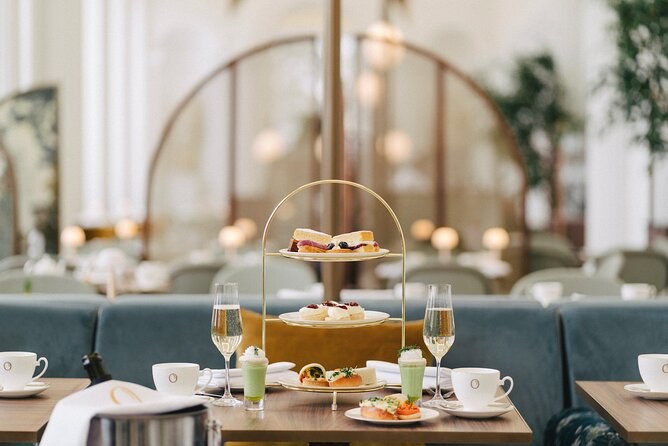
Queen Anne had it built in 1704 to keep her citrus trees alive over the winter, probably to a Wren design executed by Hawksmoor and possibly revised by Vanbrugh. It now serves afternoon tea, which is what most of the guided trips here are built around.
8. Kent got the state rooms because he was cheaper and newer
George I passed over Sir James Thornhill, the most established decorative painter in England, and gave the Cupola Room to William Kent in 1722. Kent had never painted a room like it. He then painted the Grand Staircase, and it made his career.
9. The staircase is full of real people
The figures leaning over the painted balustrade are George I's actual household: Peter the Wild Boy, the Turkish grooms Mustapha and Mahomet, the King's Polish page, the yeomen of the guard, and Kent himself. What you see inside names them.
10. There is a working weather instrument on the wall
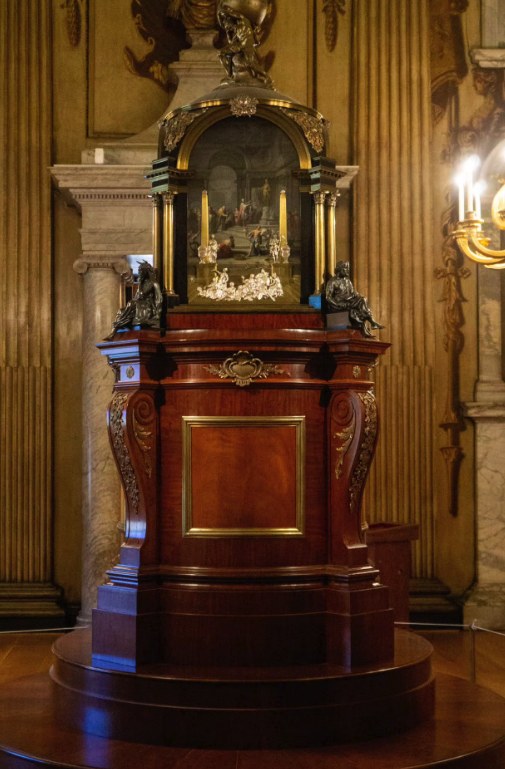
The King's Gallery wind dial was made for William III by Robert Morden in 1694. Rods run from it up to a vane on the roof, and the pointer moves with the wind. It is a painted map of north-western Europe and it still tells you the truth.
11. A queen was born here by accident of politics
The Duke and Duchess of Kent were living in an apartment at Kensington when Princess Victoria was born on 24 May 1819. She was fifth in line and nobody expected her to reign. She was christened in the Cupola Room and woken in this building in 1837 to be told she was Queen.
12. Victoria saved it from demolition
By the end of her reign the state rooms were in poor condition and there was pressure to pull them down. She refused, the rooms were restored, and they opened to the public in 1899. Every ticket sold since exists because of that decision.
13. The Sunken Garden was built on a rubbish heap
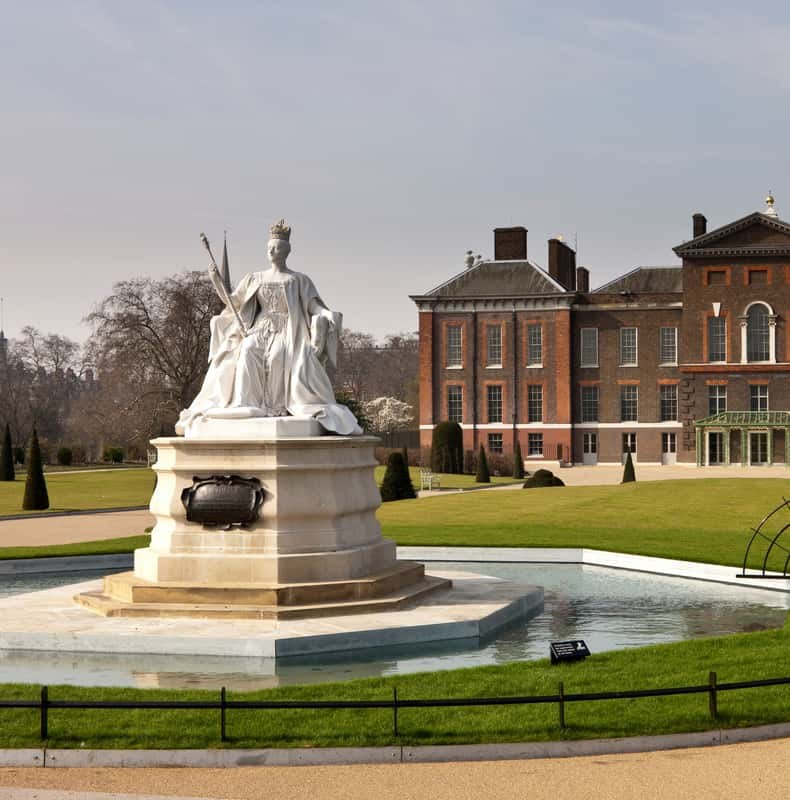
Edward VII had it laid out in 1908 on ground that until then held potting sheds and greenhouses. It was modelled on the Pond Garden at Hampton Court, replanted white in 2017, and given Ian Rank-Broadley's statue of Diana in 2021. The gardens covers the rest of the park.
14. It is the third most visited palace in the country
Over 400,000 people a year, which sounds like a lot until you stand in the King's Gallery on a Wednesday morning and find yourself alone in it.
15. Nobody is allowed to guide you round it
Historic Royal Palaces does not permit guided commentary in the State Apartments. Every commercial tour ends at the door. The multimedia guide that replaces the guide runs in nine languages plus British Sign Language and costs nothing on top of admission.
The three that change how you plan a visit
Most of the list above is worth knowing. Three of them change what you should book, and you can act on all three before you leave home.
- Nobody guides you inside. The cheapest ticket gives you exactly the same information as the most expensive tour, so what you are choosing between is what happens before you reach the door.
- It is closed on Mondays and Tuesdays. Two days out of seven, and the two that most short trips start on. Plan your visit has the full timetable.
- The gardens are free and never close. The Sunken Garden, Diana's statue, the Round Pond and the Italian Gardens cost you nothing, so a closed day still gives you most of what you came to see.
One fact that is not a fact
You will read that you can see Diana's apartments. You cannot, whatever you book. Apartments 8 and 9, where she lived from 1981 until 1997, are private and have never been open to visitors, and neither is Apartment 1A. Several travellers say in their reviews that they arrived expecting her rooms and found rooms about Victoria's childhood instead.
What you can see of Diana here is outdoors and free: the Sunken Garden she was fond of, replanted white in 2017, and the statue unveiled there in 2021. Knowing it before you go saves you a small disappointment on the day.
The fifteen, in one table
| Fact | Date | Where it is checked |
|---|---|---|
| Built as a private house | 1605 | Architectural histories |
| Bought for £20,000 | 1689 | Historic Royal Palaces |
| Wren and Hawksmoor extend it | 1689–96 | Historic Royal Palaces |
| Christmas Eve move-in | 1689 | Historic Royal Palaces |
| The Orangery built | 1704–05 | London Gardens Trust |
| Kent paints the Cupola Room | 1722–23 | Historic Royal Palaces |
| The wind dial installed | 1694 | The National Archives drawings |
| Victoria born | 24 May 1819 | Historic Royal Palaces |
| State rooms open to the public | 1899 | Historic Royal Palaces |
| Sunken Garden laid out | 1908 | London Gardens Trust |
| Diana statue unveiled | 2021 | Historic Royal Palaces |
Sources checked August 2026. One booking listing dates the palace to "Sir Christopher Wren between 1789 and 1794"; Wren died in 1723.
Kensington Palace Tours compares every bookable way in, and Kensington Palace inside tour is the fastest route to the one that fits your day.
Tours that fit this trip
Chosen for what this post covers rather than for what sells.