Kensington Palace Room by Room: What You See Inside
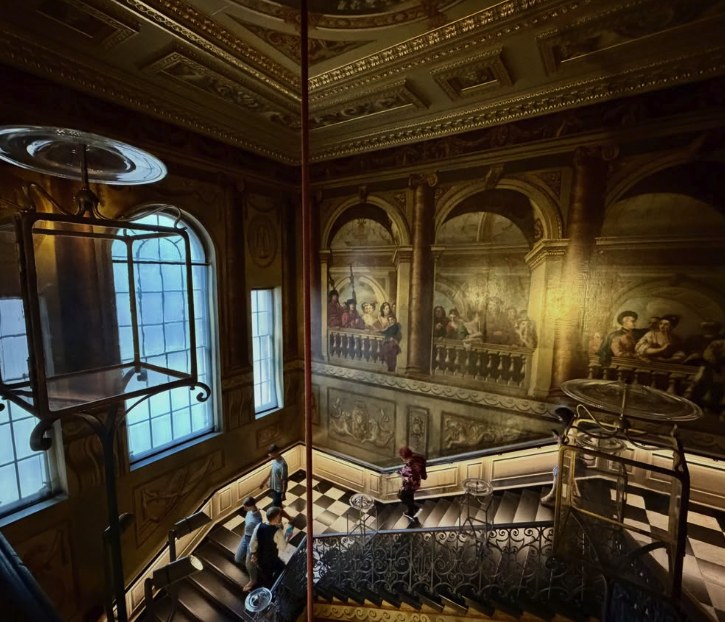
The King's Grand Staircase
You climb this first and most visitors take their first photograph here rather than in any state room. William Kent painted the walls in the 1720s with a gallery that is not there: George I's own household leaning over a trompe-l'oeil balustrade to look down at you. Peter the Wild Boy is among them. So are the King's Turkish grooms Mustapha and Mahomet, his Polish page, the yeomen of the guard, and Kent himself.
Jean Tijou made the wrought-iron balustrade you actually hold. The chequered stone floor below is the one the Georgian court crossed. Stand at the top and look back down: the painted figures are arranged for exactly that view.
The Cupola Room
George I handed Kent this room in 1722, ahead of the far more established Sir James Thornhill, and it was Kent's first royal commission. He painted the ceiling in 1723 as a coffered dome that is flat. Gilded statues stand in niches around the walls. The infant Princess Victoria was christened here in 1819.
At the centre stands Charles Clay's musical clock, the Temple of the Four Grand Monarchies of the World. Clay died before it was finished and John Pyke completed it in 1743. The case is by Roubiliac, the painted dials by Amigoni and the silver reliefs by Rysbrack, and the four monarchies at its corners are Assyria, Persia, Greece and Rome.
The King's Gallery, and the wind dial
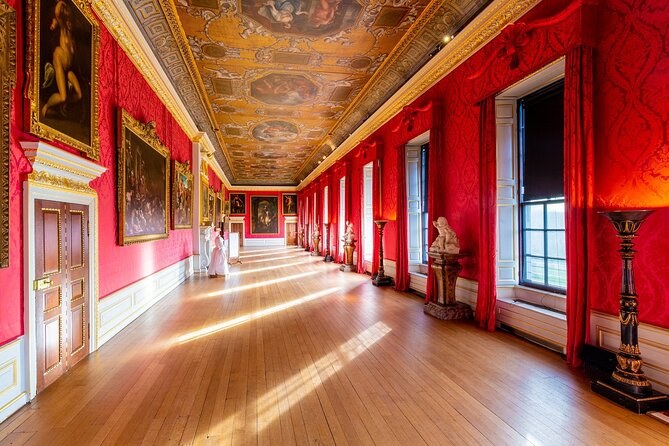
Ninety-six feet of crimson damask hung with pictures from the Royal Collection. Above the chimneypiece is the detail no tour listing mentions and no visitor forgets: a wind dial made for William III by Robert Morden in 1694.
The face is a painted map of north-western Europe with the compass points around the rim, and the pointer is driven by rods running up to a weather vane on the roof. It still works. The corners carry painted scenes of the four continents, probably by Robert Robinson, and Kent designed the marble chimneypiece around the whole thing a generation later.
Victoria's childhood rooms
These are presented as rooms rather than as a gallery about a queen, and it is the better choice. The bedroom holds a satinwood bed under a green half-tester with a curtained cot beside it, which is the arrangement Victoria was born into on 24 May 1819.
Her dolls are here, and her journals. So are the conditions of the Kensington System, the regime under which she was never left alone and did not sleep in a room of her own until the morning she became Queen. She was woken in this building in June 1837 to be told.
The Jewel Room
Open all year and included in standard admission, which is not obvious from any tour page. It holds the emerald parure Prince Albert designed for Victoria with the jeweller Joseph Kitching: the tiara of 1845, and the necklace of nine oval emerald clusters, the pendant earrings and the twenty-carat brooch of 1843. Beside them are the Fife tiara, accepted by the nation in lieu of inheritance tax, and the diamond kokoshnik of Princess Louise, Duchess of Fife. Several had not been publicly displayed for decades.
What is closed, and what that means for a 2026 visit
The Queen's State Apartments — the Queen's Staircase, Gallery and Closet, the rooms of Mary II and the palace's earliest years — closed on 15 June 2026 for conservation and re-presentation. They reopen in spring 2027.
| Room | Status | Time to allow |
|---|---|---|
| King's Grand Staircase | Open | 10 minutes |
| Cupola Room | Open | 10 minutes |
| King's Gallery | Open | 15 minutes |
| Victoria's childhood rooms | Open | 25 minutes |
| The Jewel Room | Open all year | 15 minutes |
| The Last Princesses of Punjab | To 8 November 2026 | 15 minutes |
| Queen's State Apartments | Closed to spring 2027 | — |
| Apartments 1A, 8 and 9 | Private, never open | — |
Room status published by Historic Royal Palaces, checked August 2026.
What you cannot see, whatever you book
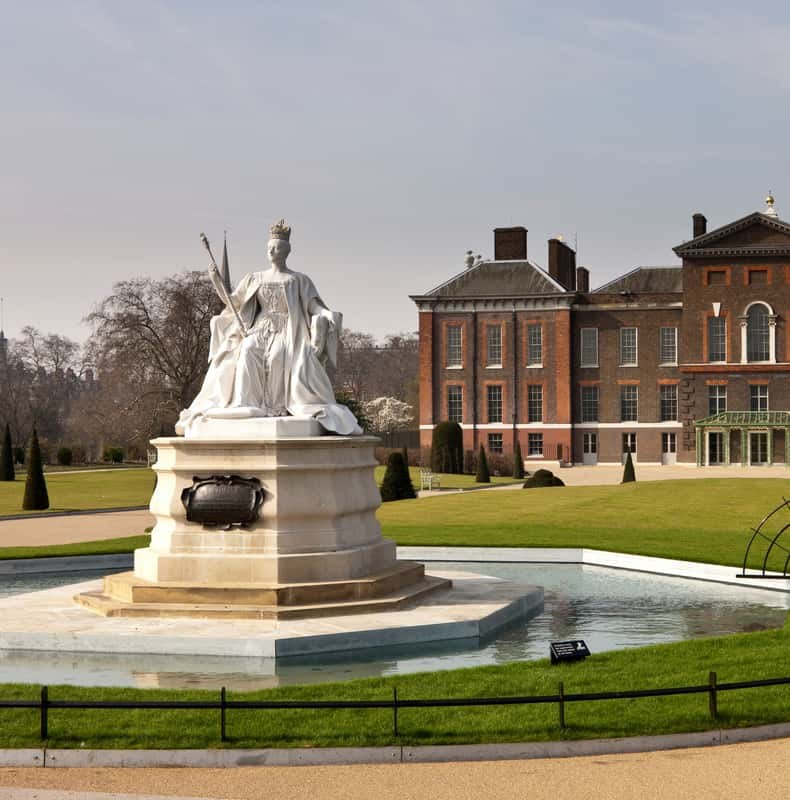
Apartments 8 and 9, where Diana lived from 1981 until 1997, are private and have never been open. So is Apartment 1A. Visitors sometimes arrive expecting her rooms and find the rooms are largely Victoria's. What there is of Diana at Kensington is outside: the Sunken Garden she was fond of, replanted white in 2017, and Ian Rank-Broadley's statue of her unveiled there in 2021. Both are free to walk up to at any time the park is open.
The Last Princesses of Punjab, to 8 November 2026
The Last Princesses of Punjab marks the 150th birthday of Princess Sophia Duleep Singh, goddaughter of Queen Victoria and a suffragette who sold newspapers outside Hampton Court and refused to pay her taxes. It sets her beside the five women who shaped her: her sisters Catherine and Bamba, her mother Bamba Müller, her grandmother Maharani Jind Kaur, and Victoria herself.
It is included in general admission and it closes on 8 November 2026. If you are coming in the last quarter of the year, check the date before you build an afternoon around it. What's on carries every 2026 date the palace has published.
What the handset actually covers
Admission includes a multimedia guide in English, French, German, Italian, Japanese, Mandarin, Portuguese, Spanish and British Sign Language. It is not an afterthought: the King's State Apartments section alone runs about twenty-five minutes, and the curators, historians and conservators who recorded it are the people who look after the building.
Two things it does not do. It will not answer a question, and it will not adjust to what you are interested in. That is the whole argument for a guided walk here — not information, which you already have, but the gardens told out loud on the way in and somebody to ask. The guided or on your own comparison works the sum through.
The order to walk it in
- First 15 minutes: the Grand Staircase, from the bottom and again from the top.
- Next 20 minutes: the Cupola Room and the clock, then the King's Gallery and the wind dial.
- Next 25 minutes: Victoria's rooms, ending at the bed and cot.
- Last 30 minutes: the Jewel Room and the exhibition.
Ask the room stewards something on the way round. They are the most-praised part of the visit in the traveller feedback on the reviews page and none of what they know is on the handset. For hours and prices, plan your visit; for the bookable trips, Kensington Palace tickets.
Tours that fit this trip
Chosen for what this post covers rather than for what sells.